
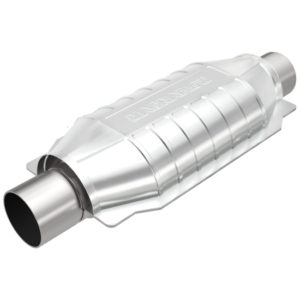
 In this article we look at the reasons that the CA catalytic converters are much more expensive to purchase than most other states. We’ll also look at some of the benefits from the more expensive converters and the different types you can use that will save you money. We will also look at some of the warning signs of a bad catalytic converter and how to at-home diagnose. How to determine your car or trucks certification requirements.
CA Catalytic Converters cost more because
Catalytic converters legally sold in CA must pass a guaranteed test that it will last 5 years or 50,000 miles. That is more than twice the guarantee from all other states that have not adopted CA rules for catalytic converters. The EPA requires a guarantee of 2 years or 24,000 miles. The catalytic converters for CA must have more than double the precious metals to pass this test.
CA created their own agency (CA Air Resources Board) and has adopted their own rules for the environment. EPA (Environmental Protection Agency) is the federal agency that is in charge of protecting the environment.
We all complain about the cost of catalytic converters, but they have cleaned up our air in California substantially. I personally remember as a child having first stage smog alerts that would prevent us from outside activity in school. I also remember not being able to see the San Bernardino mountains daily, and my chest hurting when taking a deep breath outside.
FMS Performance believes that we could have had the same effect using the catalytic converters recommended by the EPA. For it would be easier to purchase a new catalytic converter every two years at an average cost of $250 compared to spending in upwards of $1000 every five years. People living in the Inland Empire of CA are hit the hardest because of a lower income level and cost of living raises every year.
For more information on CA Approved catalytic converters visit FMS Performance. Or ask us a question here. We offer a wide range of approved catalytic converters at great prices. No credit check financing available.
Types of Catalytic Converters
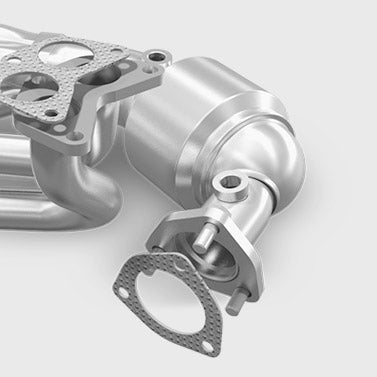
DIRECT-FIT CATALYTIC CONVERTERS
For an OEM precise fit and easy bolt-on install, shop FMS Performance Direct-Fit Catalytic Converters to find the best replacement for your vehicle at the best price.

Have an exhaust manifold? Shop FMS Performance for your Manifold Catalytic Converters to meet your exhaust manifold demands and local emissions requirements.

For a universal fitment that covers a wide range of vehicle applications, explore FMS Performance. Universal Catalytic Converters. Professional install required. We install
CA Approved Catalytic Converter
Catalytic Converter WARNING:
Catalytic Converters are emission control devices that are designed to last the life of the vehicle and do not normally require replacement without cause. A check engine light for catalytic efficiency does not by itself condemn a catalytic converter. There could be another reason or even more parts that have failed and do not necessarily require a catalytic converter replacement. Hence per example an oxygen sensor not functioning correctly. Your vehicle should be diagnosed properly before a catalytic converter is to be replaced. If you would like to schedule an appointment for a complete diagnosis, click here.
My car has a PO420! Does that mean my converter is bad?
NO. The P0420 code, by definition reads “bank one Catalyst Efficiency low” as a result most people will just replace the converter. A vehicle displaying this code is indicating that something is causing the converter to operate out of specification. Furthermore, a diagnostic and certainly an inspection are required before condemning any parts as “bad” or defective.
While you still may need a catalytic converter. FMS can perform a Catalytic Converter Pre-Test. The inspection is free with the purchase of needed components to correct the issue. Please make an appointment to drop the vehicle off for the complete inspection.
WARNING SIGNS OF A BAD CATALYTIC CONVERTER
If your vehicle has any of these warning signs, then your old catalytic converter may need to be replaced.
-
- Check engine light: If you have a 1996-or-newer (OBDII) vehicle, a check engine light may indicate a problem with your catalytic converter. A diagnostic scan tool plugged into the OBDII port under the dash may show a P0420 or P0430 code.
- Sulfur smell: If you smell rotten eggs when your vehicle is running, then the catalytic converter may not be catalyzing the sulfur in the exhaust gas.
- Emissions test failure
- Exterior discoloration
- Sluggish acceleration
- Decreased fuel economy
- Hard-start/no-start engine condition
AT-HOME DIAGNOSIS
If any of the warning signs are present, then two at-home tests may help identify a bad catalytic converter. If you don’t have the tools or the inclination, then an auto repair/muffler shop, dealer or mechanic can perform these tests for you.
-
- Exhaust temperature: Once the engine is up to normal operating temperature, measure the exhaust temperature directly, before and after the converter, using an infrared thermometer. If there is a big difference (at least 100 degrees), then the converter may need to be replaced. A large temperature difference can result from a clogged converter that traps exhaust gasses and makes it less efficient.
-
- Engine vacuum: If there is no check engine light on or your vehicle was built before 1996 (pre-OBDII), then an engine vacuum test may be necessary if there are other warning signs. When the engine is idling, hook up a vacuum gauge to the intake manifold and record the reading. Then, rev the engine to 2,500 RPM (a helper will make this easier) and observe the measurement again. If the gauge doesn’t return to a similar reading as it showed when idling, or it is very slow to do so, the converter could be faulty.
To find the right catalytic converter for your vehicle, CLICK HERE!
Have questions? Give us a call at 1-800-833-0945 and we’d be happy to help.
How can I determine my cars emissions certification levels?
All vehicles will come with a VECI (Vehicle Emission Control Information) label located in the engine compartment.
How do I know that the catalytic converter I purchase is (CARB) California Air Resource Board approved?
You can check with CARB on the approval for your car or truck by contacting the Helpline at 1-800-242-4450. You may also contact FMS for a quote or another opinion or 1-800-833-0945. Finally, you may click this link to select your search https://ssl.arb.ca.gov/AftermarketParts/catalysts